The Metropolitan Chapter has been the custodian of its rich history for seven centuries and intends to remain so, with ever more modern and careful care and organisation. To this end, it maintains the daily Liturgy and the celebration of the great feasts of Corpus Christi and the Immaculate Conception, constantly tends the devotion to the Virgen de los Reyes and carries out extensive sacramental ministry as the first church of the Diocese of Seville. In 2008 the oldest plan of the cathedral was found in the Bidaurreta Monastery in Oñati (Gipuzkoa).
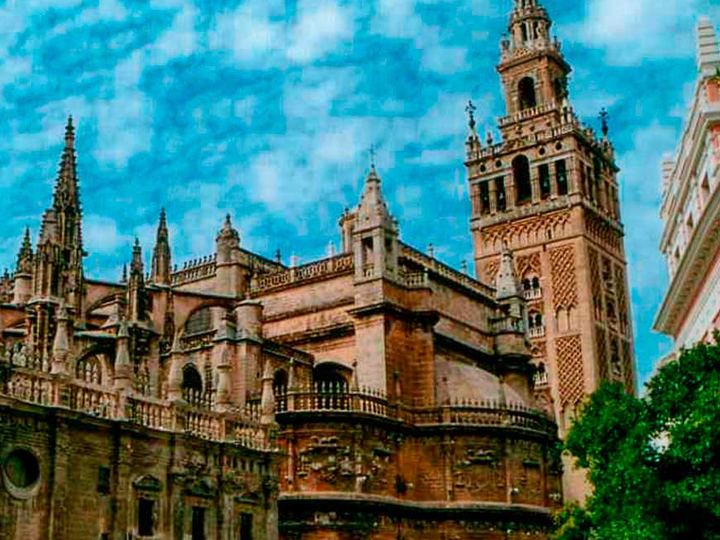
The Cathedral is an unusual building with five naves, laid out with a perfect Muslim orientation, facing east. Its most controversial aspect is that it lacks a chevet in the usual Gothic sense, in the form of an apse without an ambulatory, since its hall plan is a perfect rectangle that corresponds to the millimetre with that of the great mosque, from which it also inherited the unusual arrangement of the doors. As for the walls, they are fairly thin. However, the chapels are separated by buttresses perpendicular to the central axis of the church, ending in 28 engaged pillars which, together with another 32 free-standing ones, support 68 pointed vaults. Natural light is scarce, as the windows are small and hold beautiful stained glass.
The Giralda, despite being free-standing, serves as the tower and bell tower of Seville Cathedral. A World Heritage Site since 1987, it stands out not only for its location and history but also for its architecture, its role over the centuries and its significance within the old town. Its square base lies 7.12 metres above sea level, with sides of 13.61 metres and a height of 104.06 metres. Its base was built in the image and likeness of the minaret of the Koutoubia Mosque in Marrakech (Morocco), although the upper finial and belfry are of European Renaissance origin.
The central nave. The impressive central nave houses two charismatic structures: the choir, flanked by great organs, and the Capilla Mayor, on four levels, which houses the main altarpiece. Between them lie three adjoining areas: the nave of San Fernando Rey, the transept (whose vaults are the highest in the whole building) and the trascoro (retrochoir). Each of these three areas corresponds to the three hierarchies of the medieval city: the royal cathedral or pantheon of the kings, the ecclesiastical cathedral or area reserved for the Archbishop and the Chapter, and the people's cathedral, towards the west.
The Royal Chapel serves as the head of the cathedral. It is a unique construction, a kind of Renaissance apse located where one would expect a large pointed ambulatory typical of the Gothic style. This chapel houses the pantheon of King San Fernando and his son Alfonso, along with the tombs of some other members of the royal family of the time. It also holds the Gothic image of Santa María de los Reyes, patron saint of the Archdiocese of Seville.
The Treasury and the picture gallery. Also worth highlighting are the church's treasures and a large number of paintings by Murillo, such as the portraits of Saint Isidore and Saint Leander; works such as Saint Teresa by Zurbarán; and the sculpted head of Saint John the Baptist. The tomb of Christopher Columbus, a mausoleum by Arturo Mélida, stands in the right arm of the Cathedral's transept; here rest the remains of the famous discoverer of America.
Visit Seville
Guided tour of the Cathedral and the Giralda
The largest Gothic cathedral in the world, Columbus's tomb and the climb up the Giralda.
from€35per person
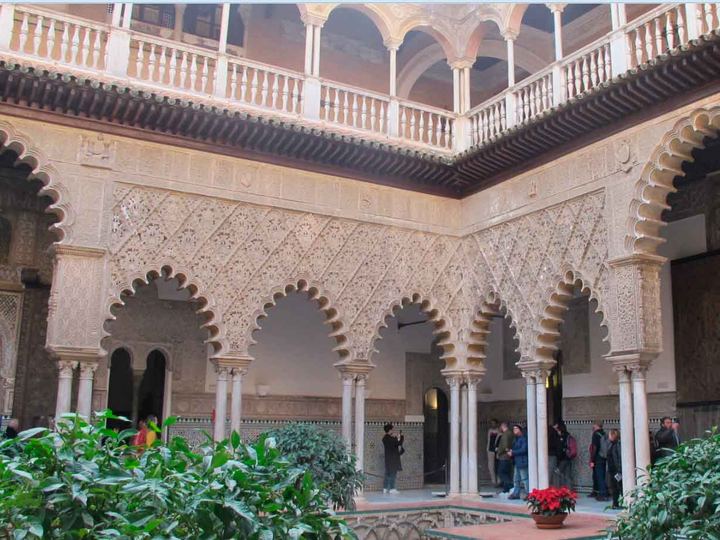
Guided tour of the Cathedral, the Giralda and the Royal Alcázar
Seville's two must-sees with the same official guide and tickets included.
from€65per person