Introduction
The Andalusian capital exudes joy and bustle in every street and square of its historic centre, which is home to a remarkable group of World Heritage buildings and neighbourhoods full of local character, such as Triana and La Macarena.
A leading business and services centre in southern Spain, Seville has a wide range of hotels spread throughout the city, from which to discover its countless attractions. Museums and art centres, theme parks, cinemas, theatres and nightclubs are just some of the endless leisure options that a great city like Seville offers. Not forgetting the many terraces, taverns and bars where you can enjoy one of the city's most deep-rooted and tasty customs: going for tapas, the “tapeo”.
Its festivals are another good reason to visit Seville. Declared of International Tourist Interest, Holy Week and the April Fair reflect the devotion and folklore of the people of Seville, always open and welcoming to visitors. But Seville is much more: it is a good starting point for exploring the whole province along a wide variety of cultural routes, such as the Roman Baetica Route or the Washington Irving Route.
You can also discover the enormous natural wealth of a region that sits between two continents, with treasures such as Doñana Natural Park, a UNESCO World Heritage Site and Biosphere Reserve, or the Sierra Norte Natural Park. They are the ideal setting for all kinds of outdoor sports, including hiking, horse riding and cycling. And if your sport is golf, Seville has four excellent courses close to the city.
Art and Culture
A blend of artistic traditions. The city of Seville has seen the most diverse civilisations pass through it. The Tartessians founded Hispalis, next to which, in 207 BC, the Romans built the important settlement of Itálica.
Founded by the general Scipio, it gave Rome two emperors: Trajan and Hadrian. The long Muslim presence, from 711 to 1248, left an indelible mark on the city. The end of the Caliphate of Córdoba (11th century) led to the heyday of the Taifa Kingdom of Seville, especially under the rule of al-Mutamid, the poet king.
The monumental ensemble formed by the Cathedral, the Royal Alcázar and the Archivo de Indias, all declared a World Heritage Site by UNESCO, is the emblem of the city. Amid the whitewashed houses of the Santa Cruz quarter rises this Gothic cathedral, built on the site of Seville's great Almohad mosque. Of this Arab heritage, the old minaret, now the famous Giralda, and the Patio de los Naranjos survive.
Next to it, the Royal Alcázar also stands on a 9th-century Arab fortress, but it is to Peter I “the Cruel” (14th century) that we owe its Mudéjar decoration. Its walls enclose numerous rooms, sumptuous halls and romantic courtyards. Its extensive gardens, with Arab and Renaissance elements, frame the whole complex.
The Archivo de Indias, for its part, takes us into Spanish Renaissance art. It is one of the most important archives in existence relating to the conquest of the New World. Another important Renaissance building in the city is the Casa de Pilatos, a palace that blends Gothic and Mudéjar elements with Renaissance features imported from Italy.
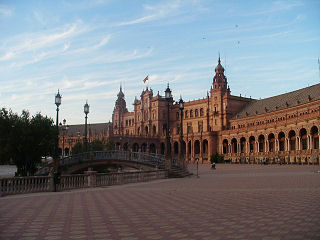
We can also visit the Baroque façade of the Royal Tobacco Factory, now the University, the Palacio de San Telmo, the María Luisa Park and the Plaza de España. In this area there are interesting buildings that are a reminder of the Ibero-American Exposition held in Seville in 1929.
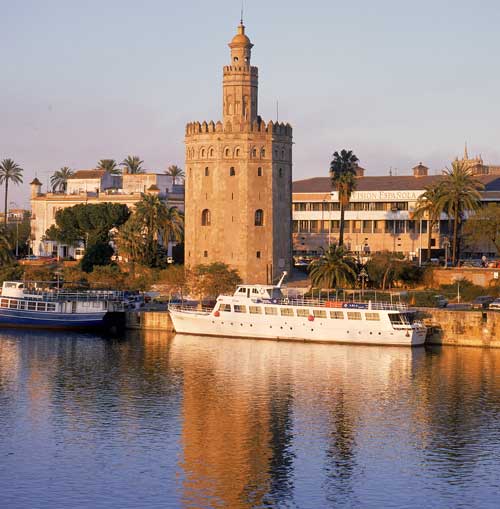
On the banks of the Guadalquivir stands the Torre del Oro, a building of Arab origin (13th century) that formed part of the old city walls. Because of its close links with Seville's maritime history, it was chosen to house the Naval Museum. Its silhouette marks the entrance to El Arenal, the bullfighting district par excellence. Here stands one of the most iconic bullrings in Spain, the bullring of the Real Maestranza de Caballería.
The centre of Seville leads us to its best-known streets, such as Sierpes and Campana, and to numerous Renaissance and Baroque churches, hospitals and palaces. In the La Macarena district you will find the Alameda de Hércules, the Hospital de las Cinco Llagas (seat of the Andalusian Parliament), the Macarena Basilica and the church of San Lorenzo. The last two house two of the images most beloved by the people of Seville: the Virgen de la Esperanza and Jesús del Gran Poder, carved figures venerated during the Holy Week processions.
Another of the city's most traditional neighbourhoods is Triana, across the river. Its deep seafaring tradition can be seen in calle Pureza, calle Betis and calle Alfarería and in the Plaza del Altozano. The parish church of Santa Ana and the chapel of the Cristo de la Expiración, where the Cristo del Cachorro is venerated, stand among colourful houses with a 19th-century feel.
La Cartuja Island lies on this side of the river, where the architectural legacy of the 1992 Universal Exhibition joins the Cartuja Monastery complex and the Andalusian Centre of Contemporary Art.
A tour of Seville will take us to museums such as the Museum of Fine Arts, one of the most important in Spain in its field. Housed in the 18th-century Convent of La Merced, it displays works by El Greco, Velázquez, Zurbarán and Valdés Leal, and above all its collection of paintings by Murillo, in the convent church.
The Cathedral Museum, for its part, displays valuable collections of gold and silverwork, paintings, reliquaries, jewels and religious vestments.
Another important museum is the Provincial Archaeological Museum, which houses the Roman collections found in the nearby city of Itálica, the Tartessian treasure of El Carambolo and other Oriental pieces. To complete the picture of the Roman world, you can see the no less interesting collection held by the Casa Museo de la Condesa de Lebrija.
But if you have enough time, you can visit the Archaeological Site of Itálica “in situ”; the tour includes the amphitheatre and the Hadrianic quarter, with admirable mosaics and sculptures from the Roman period.
Nor should you forget the Museum of Popular Arts and Customs, home to a curious collection of old costumes, lathes and bakery ovens, as well as folk furniture from the 18th and 19th centuries.
Other art centres and galleries, such as the Bullfighting Museum, the Focus Foundation and the Exhibition Hall of the Monastery of San Clemente, complete Seville's attractive cultural scene.
Visit Seville
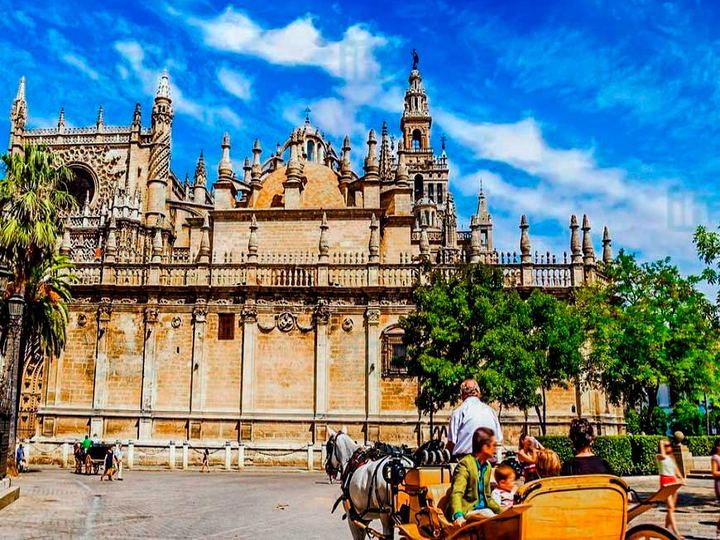
Essence of Seville: horse-drawn carriage ride
Plaza del Triunfo, Torre del Oro, María Luisa Park and Plaza de España in a horse-drawn carriage.
Free, no-obligation quote
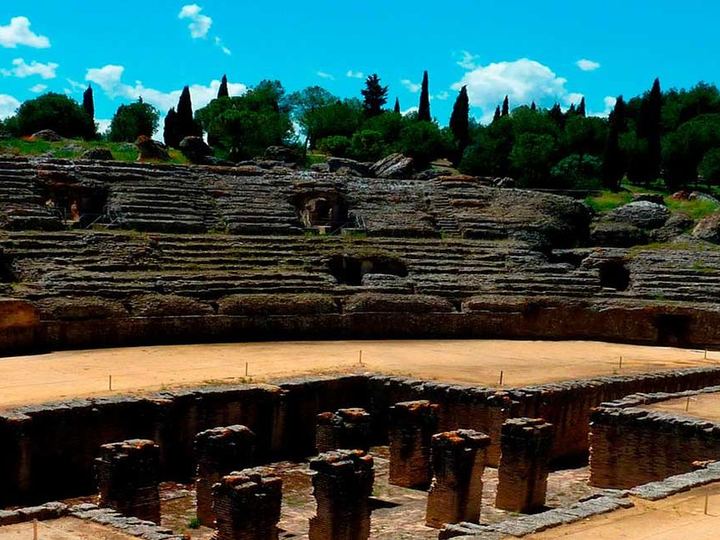
Guided tour of Itálica
The first Roman city in Hispania: amphitheatre, mosaics, baths and theatre. With or without a bus from Seville.
from€21per person