After the event
Of the buildings planned, 22 in total within the grounds – the Hotel Alfonso XIII, 8 official pavilions, 12 Spanish regional ones, 7 provincial (Andalusian) ones, one municipal, 13 from foreign states and 47 commercial ones – only a few dozen survived into the early 21st century, some heavily altered. Among them we can enjoy (current use in brackets):
- Plaza de España (municipal offices and tourist landmark)
- María Luisa Park and the landscaping of the grounds
- Domecq Pavilion (headquarters of Juventudes Musicales)
- Mudéjar Pavilion (Museum of Popular Arts and Customs)
- Royal Pavilion (municipal offices)
- Seville Pavilion (Teatro Lope de Vega)
- Fine Arts Pavilion (Archaeological Museum)
- Information Pavilion (now the "La Raza" restaurant)
- Press Pavilion ("España" state school)
- Morocco Pavilion (Parks and Gardens department)
- Pavilion of the Compañía Arrendataria de Tabacos (archives)
- Argentina Pavilion (dance school) (architect Martín S. Noel)
- Chile Pavilion (School of Applied Arts and Artistic Crafts)
- Colombia Pavilion (Nautical School)
- Cuba Pavilion (Government Delegation of the Junta de Andalucía)
- Guatemala Pavilion (Dance School)
- Brazil Pavilion (Vice-Rectorates of the University of Seville)
- United States Pavilion (Valentín Madariaga Foundation Museum) (architect William Templeton Johnson)
- Mexico Pavilion (Vice-Rectorate for Postgraduate and Doctoral Studies, University of Seville) (architect Manuel Amábilis)
- Peru Pavilion (Spanish National Research Council, CSIC)
- Portugal Pavilion (Consulate of Portugal)
- Santo Domingo Pavilion (State Roads Department in Andalusia)
- Uruguay Pavilion (administrative offices of the University of Seville)
- Basque Provinces Pavilion (Cancer Institute, until recently)
- Telefónica Pavilion (Joaquín Romero Murube School of Gardening and Centre for Environmental Studies)
- Navy Ministry Pavilion (Naval Command)
- Stadium (home of Real Betis Balompié football club)
- Hotel Alfonso XIII (still a hotel, ***** GL)
- Galleries (Port Works warehouses)
- Quinta de Goya (Bar Citroën)
- Amusement park electricity hut (still a Sevillana Endesa substation)
- Exposition Casino (cultural and social venue, and meeting place of the Seville European Film Festival)
- Red Cross Pavilion (Ministry of Health)
It is also worth noting that in the part of the Southern Sector where the Reina Mercedes university campus now stands, there was a square called Plaza de los Conquistadores with a Monumental Fountain featuring three statues: one representing the Iberian Peninsula, another the River Guadalquivir and a third an American river. These statues now stand on the rear lawn of the Jardines de las Delicias, recently restored and extended towards the river, next to the Delicias quay. The square also had statues of conquistadors, of which only one remains in its original location, in the gardens of the Hernando Colón hall of residence; the statue of Pinzón is in the town hall square of Palos de la Frontera, and in Jerez de los Caballeros there are two statues, one of Columbus in the Parque de Santa Lucía and another at the entrance to the town in front of a Romanesque-style arch.
The Liliput train
During the exposition there was a peculiar and very successful means of transport that delighted young and old alike: the so-called Liliput Train or miniature railway. All that remains of this attraction is one locomotive (named Santa María), which stands at Santa Justa Station at the entrance to the headquarters of the Seville Association of Railway Friends.
Source: patios.cordoba.es
Visit Seville
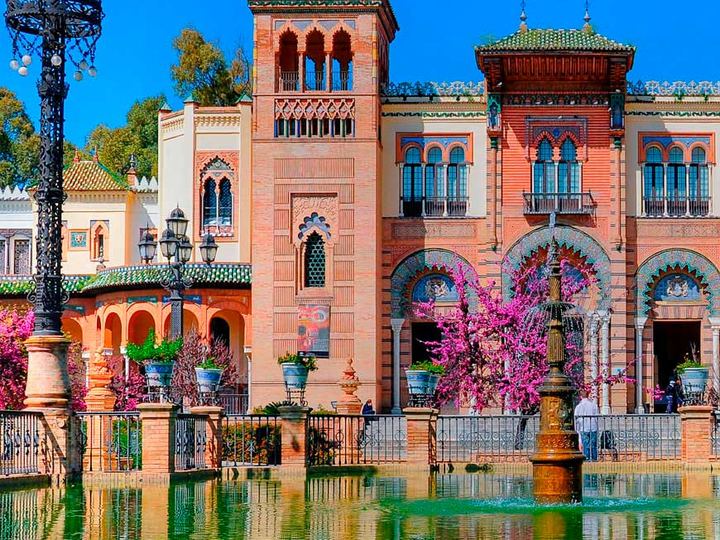
Private visit: María Luisa Park and Plaza de España
The Royal Tobacco Factory, the 1929 pavilions, the Archaeological Museum and Plaza de España.
from€212per group
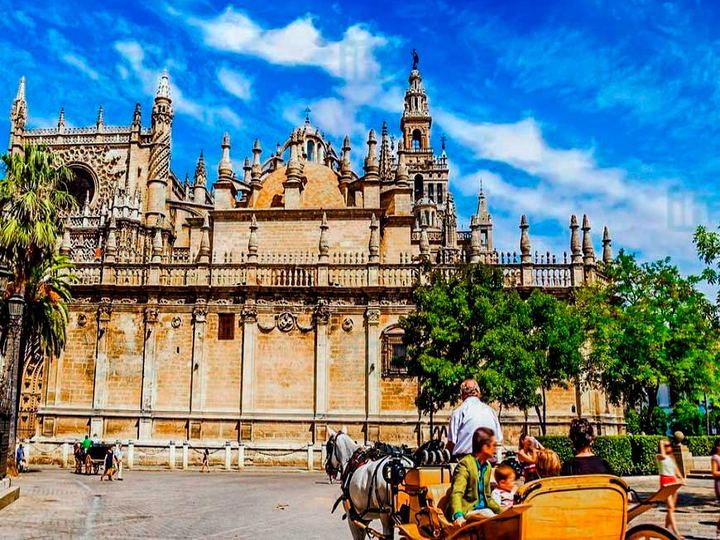
Essence of Seville: horse-drawn carriage ride
Plaza del Triunfo, Torre del Oro, María Luisa Park and Plaza de España in a horse-drawn carriage.
Free, no-obligation quote