Location and pavilions
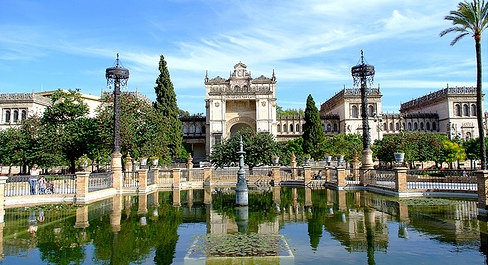
The María Luisa Park, donated in 1893 by the Infanta María Luisa de Borbón and redesigned by the French engineer Jean Claude Nicolas Forestier, curator of the Bois de Boulogne in Paris, who gave it a romantic touch inspired by the gardens of the Generalife, the Alhambra and the Royal Alcázar of Seville. The Plaza de España and the Plaza de América were laid out in the park.
The Prado de San Sebastián, where the Portugal Pavilion was built
The San Telmo gardens, site of the Seville Pavilion, made up of the Teatro Lope de Vega and the Exposition Casino
The Paseo de las Delicias
The Southern Sector.
Aníbal González, appointed chief architect of the exposition, was largely responsible for the development of the 1,343,200 m² the exposition covered. In 1928 Aníbal González resigned and Vicente Traver was appointed architect.
The disorganisation in 1926 affected the location of each pavilion; they had originally been planned in such a way that in the end they overlapped one another.
The main architectural legacies of the Exposition were the group of pavilions around the Plaza de América, designed in 1913 by Aníbal González, which brought together and arranged three buildings in the María Luisa Park: the so-called Mudéjar Pavilion, now the Museum of Popular Arts and Customs, the Fine Arts Pavilion, now the Archaeological Museum, and the Royal Pavilion.
In 1914 Aníbal González also drew up the most ambitious project of the whole exposition, the Plaza de España, comprising the great palace and the square it encloses; construction went on until 1928 and it was opened in 1929.
Participants
The most notable participants in the Exposition were Argentina, Brazil, Chile, Colombia, Cuba, the United States, Morocco, Mexico, Peru, Portugal and Uruguay, the Spanish regions and the Andalusian provinces, including Huelva, which at first did not agree with Seville hosting the event.
Exhibitions
Several exhibitions were held. Early art was displayed in the Mudéjar Pavilion (now the Museum of Popular Arts and Customs) and in the Plaza de España. There was also a survey of the history of printing from the time of Johannes Gutenberg to the latest technologies known at the end of the 1920s.
Visit Seville
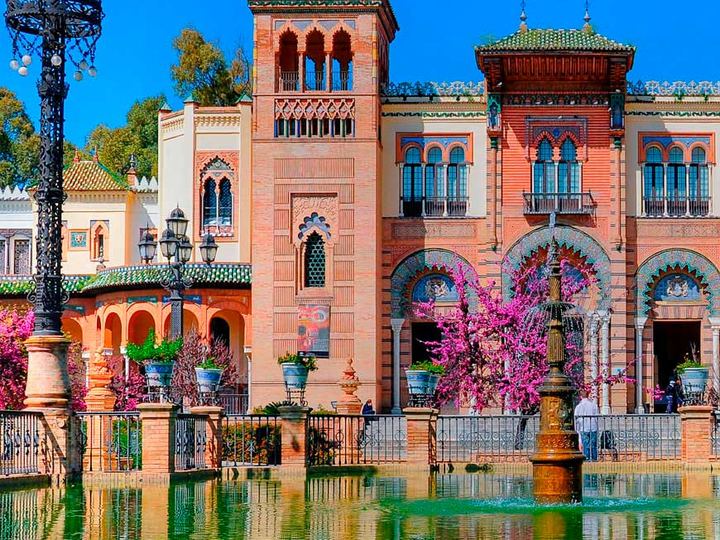
Private visit: María Luisa Park and Plaza de España
The Royal Tobacco Factory, the 1929 pavilions, the Archaeological Museum and Plaza de España.
from€212per group
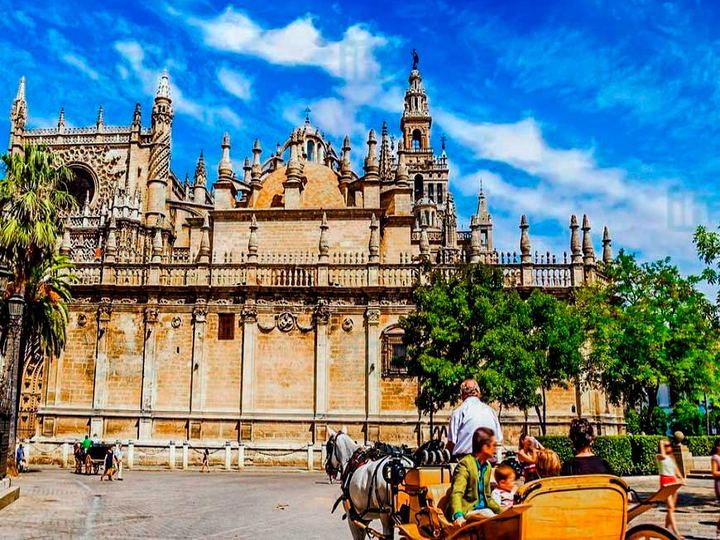
Essence of Seville: horse-drawn carriage ride
Plaza del Triunfo, Torre del Oro, María Luisa Park and Plaza de España in a horse-drawn carriage.
Free, no-obligation quote