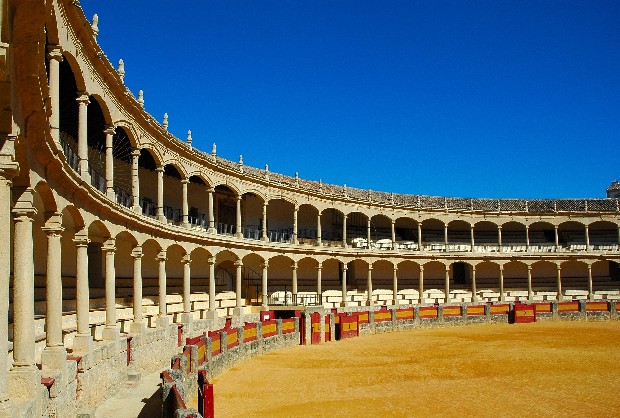
The bullring is owned by a noble corporation based in Seville, the city that gives it its name. Made up of gentlemen from old noble families, it carries out many charitable and social activities, promotes equestrian art and supports bullfighting. Cultural and artistic patronage is another of its activities. In 1966 it created prestigious awards for the best academic records in the Faculties and Schools of the University of Seville, and it also grants major art and research prizes, such as awards for young researchers, and sponsors activities by the city's cultural institutions, as well as holding concert series and art exhibitions of varied content.
Around the bullring there are statues of the Sevillian bullfighters who have triumphed most there, notably the one dedicated to the bullfighter Curro Romero.
History
In 1749 work began on a circular bullring on the Baratillo hill, replacing the rectangular bullring that stood there. Later, in 1761, construction was carried out in sections (each section equivalent to four arches). The master builders in this first stage were Francisco Sánchez de Aragón and Pedro and Vicente de San Martín. The inner façade of the bullring, known as the Prince's Box, was completed in 1765. This box has two levels: the gate into the ring, through which triumphant bullfighters leave, and the box itself, reserved exclusively for the Royal Family. Its upper part consists of four arches supporting a half-orange dome, covered on top with white and blue tiles. The sculptural group crowning it is the work of the Portuguese sculptor Cayetano de Acosta. The box was built for the Infante of Spain, Philip of Bourbon, son of Philip V and Elisabeth Farnese.
When Charles III banned bullfights in 1786, the work stopped and was considered finished, although only a third of the bullring had been built. Also from this period is the old Diputación Box, later called the Breeders' Box, located above the bull pen gate and opposite the Prince's Box.
The roof over the stands of half the bullring was completed 34 years later, to the left and right of the Prince's Box, leaving a view of the Cathedral and the Giralda open from the stands, as shown in many prints of the time.
In 1868 the Diputación Box was in such a sorry state that it was improved, with a new floor and a marble balustrade, as well as the coat of arms of the Real Maestranza de Caballería, by the Italian sculptor Augusto Franchy. Five balconies were also built on each side of the Diputación Box, where the bullring clock now stands.
The construction of the bullring was completed in 1881, closing it entirely; two thirds of it were then built in stone and the rest in wood.
Between 1914 and 1915 the stone stands were replaced with brick ones under the direction of the Sevillian architect Aníbal González. All the stands were rebuilt with a gentler slope. The number of rows in the shaded stands rose from ten to twelve, and to fourteen in the sunny ones, plus three rows of front seats. At the top of the shaded stands, in front of the boxes, a row of armchair seats was built.
Bullfighting Museum
Around the bullring there are statues of the Sevillian bullfighters who have triumphed most there, notably the one dedicated to the bullfighter Curro Romero. The Bullfighting Museum of the Real Maestranza de Caballería is housed beneath the stands of the bullring and was created in 1989. There visitors can explore the history of bullfighting through a collection of paintings, bullfighting posters, photos, bullfighters' costumes, bronzes, tiles and sculptures; highlights include works by Mariano Benlliure and busts of legendary bullfighters such as Curro Cúchares, Pepe-Hillo and Espartero.
Visit Seville
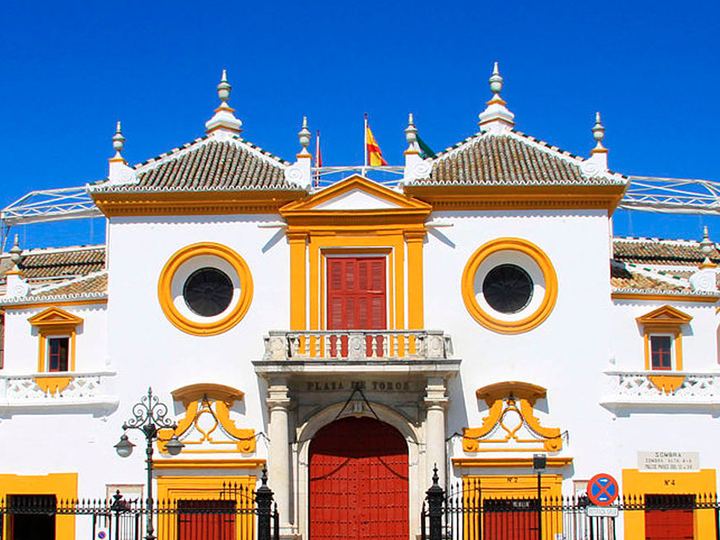
Private tour: Maestranza, Hospital de la Caridad and Arenal
The bullring and its museum, the Baroque Hospital de la Caridad and the Arenal quarter.
from€212per group
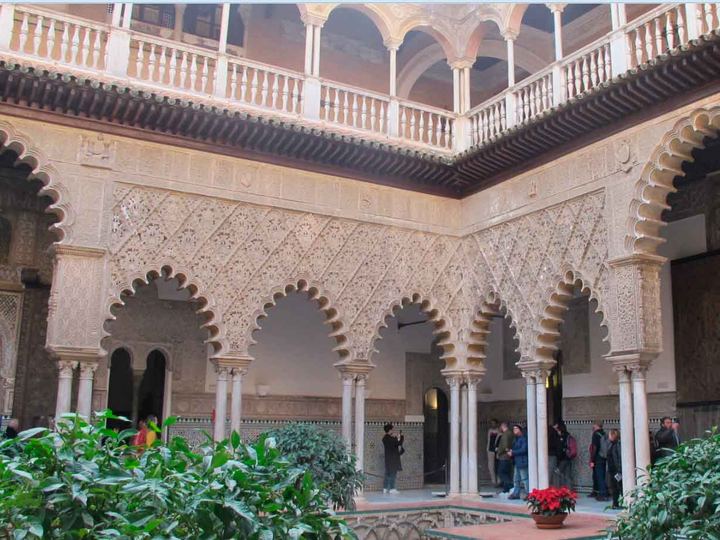
Guided tour of the Cathedral, the Giralda and the Royal Alcázar
Seville's two must-sees with the same official guide and tickets included.
from€65per person