Description
Seville's roots go back into a mythical haze three thousand years ago when, as the motto says, “Hercules founded it”. Occupying a strategic location at the very point where the Guadalquivir opens up to the influence of the ocean, in an unbeatable position for both land and sea trade, it emerged in the first centuries of the first millennium BC, as part of the kingdom of Tartessos and within the orbit of the Phoenician colonies. Later, the Carthaginian presence gave way to Rome. Hispalis, the old Seville, became one of the capitals of the prosperous province of Baetica, facing its aristocratic neighbour and rival, Itálica, birthplace of Trajan and Hadrian. In Visigothic times it kept its pre-eminence, standing out around the 6th century as one of the most active centres of learning in Europe. Brought under Muslim rule in 712, it was briefly the capital of the fledgling state of al-Andalus, until the capital moved to Córdoba. Ishbiliya, Andalusi Seville, would rival that other great city on the Guadalquivir, often rising up against its rulers. Finally, the break-up of the caliphate in the 11th century led to the splendour of Ishbiliya under the Arab Abbadid dynasty, who made it the court of the largest and most powerful of the Andalusi taifa kingdoms. Al-Mutadid and his son al-Mutamid, the famous poet king, presided over its heyday, fostering an extraordinary cultural and artistic flowering. It was by now the court where everything ended up, a cosmopolitan emporium at the crossroads of seas and continents.
The North African empires of the Almoravids and Almohads then boosted the importance of Ishbiliya and gave it its definitive urban shape. While the Almoravids laid out the long circuit of walls that still marks the boundary of its large historic centre today, the Almohads raised it to the seat of their empire in al-Andalus. From the 12th century, Seville was among the leading cities of Europe.
The brilliant Muslim period of Ishbiliya came to an end in 1248, when it surrendered to Ferdinand III. Along with Seville fell the whole of the Lower Guadalquivir. Once again it became a princely seat, its history and legend especially bound up with the figure of Peter I, whose Seville court forged a happy synthesis by absorbing the currents of Hispanic Islam. As well as an outpost facing the last Muslim stronghold, Granada, Seville was also the bridgehead of a trade route with the Nasrids, precisely the route these pages follow. With the discovery of America, the city reached its zenith, a new Babel where people from all over the world mingled. Golden decades that, in their decline, led to the Romantic century, to the traditional city that delighted travellers with its customs and its pleasant appearance. Writers, painters and illustrators, and simple tourists, were seduced in droves from the early 19th century, captivated by the dream of its myths – Don Juan, Figaro, Carmen –, by its people and by the spell of its streets.
This road linking the capitals of caliphal and Nasrid al-Andalus – Córdoba and Granada – was one of the busiest in the Iberian Peninsula in the Middle Ages, travelled by merchants from all over the known world who supplied and traded with these important towns; it was also the road of knowledge, of the sciences and the arts.
Córdoba was the capital of learning of the Muslim West during the caliphal period. It was one of the most advanced cities of its time, and as Ch. E. Dufourcq wrote: "At no time did Rome or Paris, the most populous cities of the medieval Christian West, even come close to the splendour of Córdoba, the largest urban centre of medieval Europe".
With this memory, the Caliphate Route aims to strengthen the bond between the three provinces it runs through – Córdoba, Jaén and Granada – and to act as an engine of development for the towns and areas along it. The Nasrid capital, Granada, and the Alhambra, the most precious jewel of Hispano-Muslim architecture, are the end point of this Route.
The settlements of different civilisations, and their remote antiquity, give Granada the character of a cultural melting pot that can be seen in its many monuments from different historical periods. The refined Andalusi spirit, evident in the architecture and gardens of the time, the language of the stones of the Renaissance monuments and the apparent fragility of Flamboyant Gothic make up a many-sided place that never fails to captivate travellers.
Visit Seville
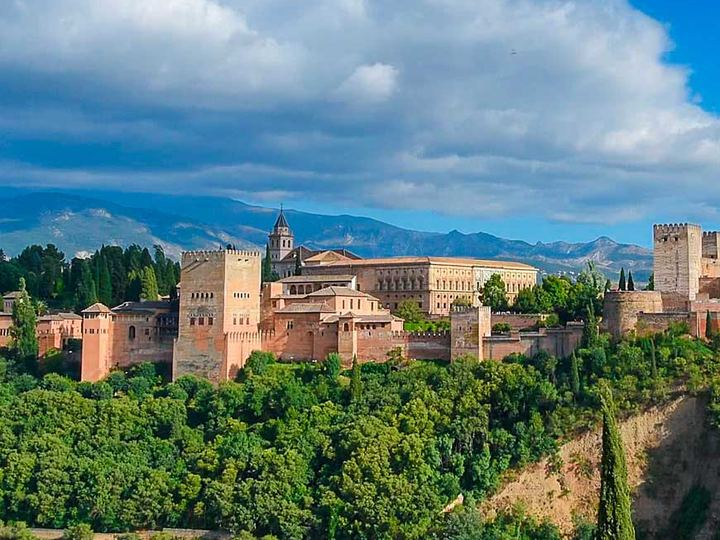
Day trip to the Alhambra from Seville
From Seville to Granada along the Washington Irving route, with the Alhambra and the Generalife.
from€149per person
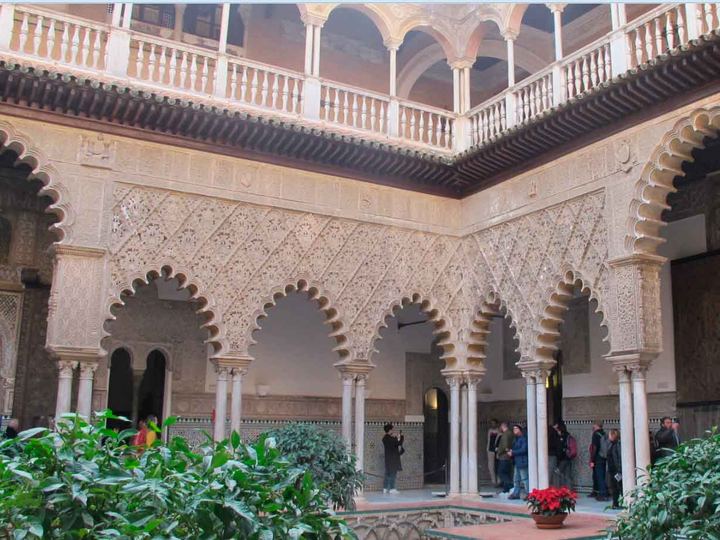
Guided tour of the Cathedral, the Giralda and the Royal Alcázar
Seville's two must-sees with the same official guide and tickets included.
from€65per person