Isbiliya, Arab Seville.
Isbiliya enjoyed great cultural wealth; although it depended on the Caliphate of Córdoba, it was one of the most important cities of Al-Andalus (the Arabic name for Andalusia). Mosques were built there, whose minarets still survive as church bell towers (e.g. Santa Catalina, San Gil, San Andrés, San Marcos, etc.).
The fall of the Caliphate of Córdoba in AD 1013-1035 led to the emergence of the Taifa kingdoms, one of which had its seat in Isbiliya. At that time Isbiliya enjoyed a period of splendour and dominance over the other taifa kingdoms under the reign of Al Mutamid (son of Ben Abbás), a cultured king who loved the arts and letters. Under his reign Isbiliya became a cultural centre of the first rank; it welcomed great poets (e.g. Aben Amar, Abd El Chalil), music schools were founded, and so on. Al Mutamid's military skills and good government are also worth highlighting.
However, to halt the expansion of Alfonso VI, king of Castile and León and Al Mutamid's son-in-law through his marriage to Zaida, the Muslim kings of Badajoz, Granada and Isbiliya agreed to seek help from abroad, specifically from the African Berbers: the Almoravids. In the end, Almoravid power turned against the taifa kingdoms themselves; the Almoravids took Isbiliya in AD 1091. They exiled Al Mutamid and imprisoned him in Tangier.
The extreme religious rigidity and social intolerance imposed by this dynasty disillusioned the people, who organised themselves into independence movements; at the same time there was an exodus of Mudéjars to the north. All this paved the way for the subsequent arrival of the Almohads, who landed at Cádiz in AD 1146.
The Almohads made Isbiliya the administrative capital of Al-Andalus. Days of well-being and prosperity followed, interspersed with times of unrest caused by frequent Castilian raids into the territory and by the periodic flooding of the Guadalquivir. Nevertheless, this did not prevent the Almohads from carrying out a major building programme (e.g. palaces, mosques, the Giralda, the Torre del Oro, etc.), notably the construction of a great mosque where the imposing cathedral now stands, and of the Bridge of Boats, linking the city with the Aljarafe and the Triana district.
After the Christian victory at Las Navas de Tolosa (AD 1212), the Almohad empire was considerably weakened; by around AD 1220 Almohad power was heading towards total decline. The Torre del Oro and the repair of the Roman walls for defensive purposes date from this period.
Visit Seville
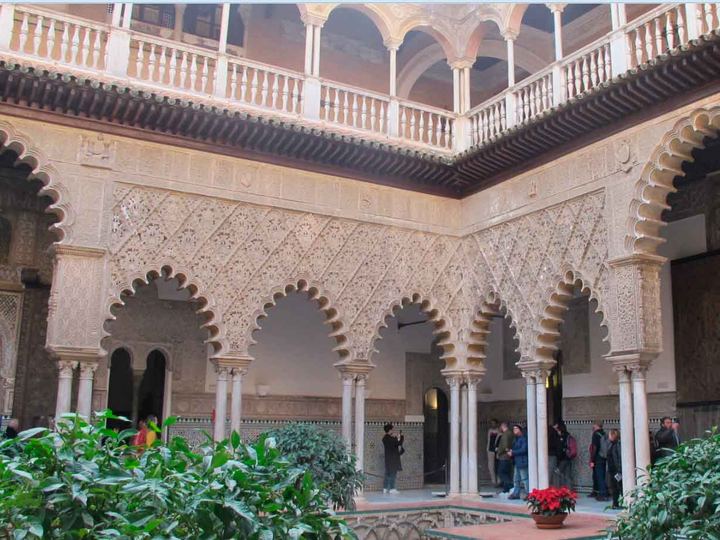
Guided tour of the Cathedral, the Giralda and the Royal Alcázar
Seville's two must-sees with the same official guide and tickets included.
from€65per person
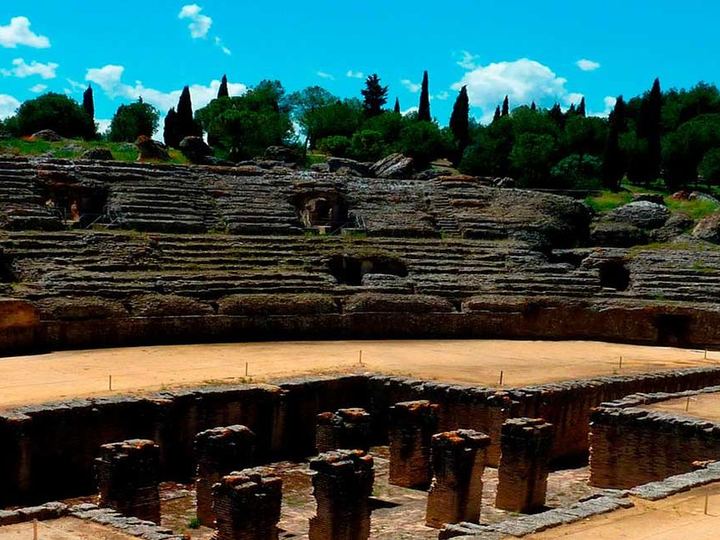
Guided tour of Itálica
The first Roman city in Hispania: amphitheatre, mosaics, baths and theatre. With or without a bus from Seville.
from€21per person