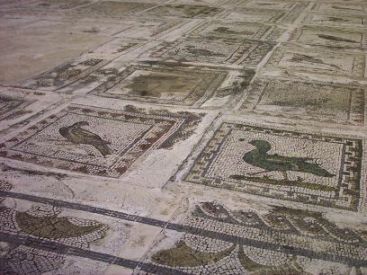
Origins: Ispal.
The Tartessian culture invented bronze, perfected navigation and created the first political state in the West. It was precisely thanks to the working of gold and silver mines and to trade with the Phoenicians that the Tartessian people reached a degree of wealth and development admired by Greek historians.
The Punic-Etruscan victory over the Phocaean Greeks at Alalia, in Corsica, in 535 BC put an end to Tartessos' trade with the Phocaean Greeks, who had succeeded the Phoenicians as its trading partners; Tartessos then began to decline. By 500 BC the Tartessian culture had finally disappeared; the Turdetani peoples may have carried on its legacy
One possible explanation for the disappearance of Tartessos therefore lies in the decline of Phoenician dominance in the Mediterranean and the power of the Punic-Etruscan alliance against the Phocaean Greeks; this spurred the expansion of the Carthaginians, who invaded Tartessos and destroyed its capital, one more move to dominate Mediterranean trade. However, whether this was a collapse caused by Carthaginian attacks or the result of the economic decline of its trade is something that cannot yet be settled.
As a result of the First Punic War, around 241 BC, the Carthaginians lost control of their main positions in the Mediterranean, and Turdetania (the Andalusia of the time), after more than two and a half centuries under the Carthaginian yoke, took the opportunity to rebel. In 237 BC Hamilcar Barca himself landed at Cádiz to put down the revolt; he defeated the insurgents, who were supported by Celtiberian mercenary forces. Nevertheless, as late as 216 BC there is evidence of uprisings and revolts among the Turdetani peoples.
Hispalis, Roman Seville.
In 206-205 BC, during the Second Punic War and after the Battle of Ilipa, the Romans drove out the Carthaginians and made the city, which they called Hispalis, part of the province of Baetica. After conquering Cartagena (209 BC), thereby depriving Carthage of a key port for sustaining its war effort in Italy, Publius Scipio advanced down the Guadalquivir, subduing the Carthaginian strongholds which, often supported by the local peoples, resisted the Roman advance. The towns of Castulo, Baecula, Ilipa and Carmo fell to the advancing Publius Scipio, who founded Itálica, the first Roman colony in Spain, near Seville.
Today, of the buildings of Hispalis, little remains apart from a few columns (in calle Mármoles), remains of a temple, and the arches of the aqueduct on Calle Luis Montoto.
As in the rest of Baetica, Christianity took hold in Hispalis from the early 1st century AD. As a sign of Christian fervour, in the 3rd century Saints Justa and Rufina (patron saints of Seville) were martyred for defending the Christian faith and refusing to worship an idol of Salambo.
Visit Seville
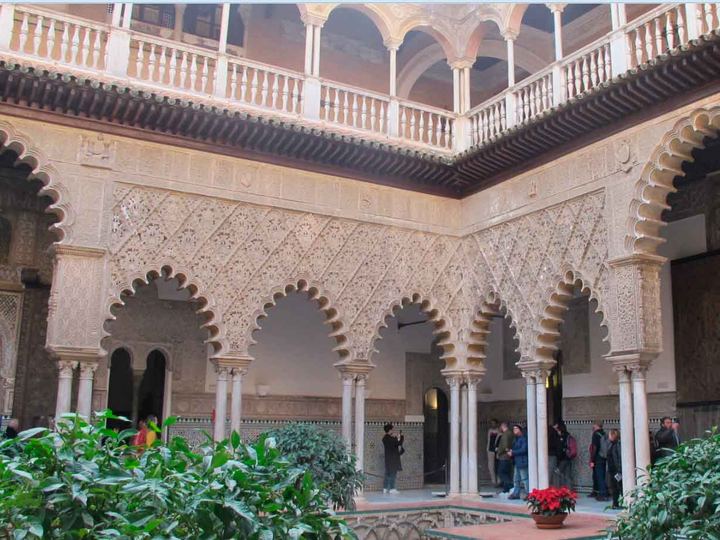
Guided tour of the Cathedral, the Giralda and the Royal Alcázar
Seville's two must-sees with the same official guide and tickets included.
from€65per person
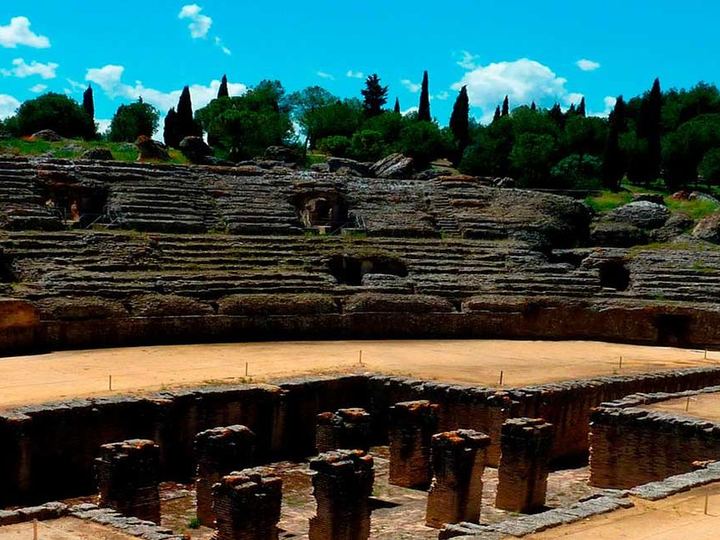
Guided tour of Itálica
The first Roman city in Hispania: amphitheatre, mosaics, baths and theatre. With or without a bus from Seville.
from€21per person