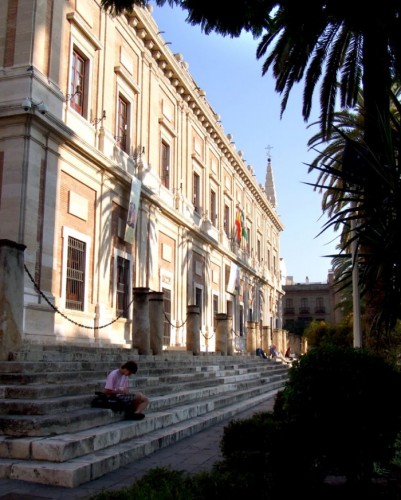
Seville and the discovery of America.
The Consulado de Indias (the merchants' guild for trade with the Indies) was founded in AD 1543 and represented all non-foreign merchants. As it had no premises of its own, many business deals were struck on the steps of the Cathedral, which forced the Cathedral chapter to surround the building with chains to stop the traders from going inside; these chains still survive. The solution came with the construction of the Casa Lonja (the merchants' exchange). Later, Charles III ordered it to be adapted to house the Archivo de Indias.
All this brought Seville a great new urban expansion, as shown by the continued work on the Cathedral at that time and the remodelling of parts of the Royal Alcázar (for example, the Patio de las Doncellas) for the wedding of Charles I and Isabella of Portugal in AD 1526, as well as other buildings: the Casa de Pilatos, the Casa de las Dueñas, the Collegiate Church of El Salvador and the aforementioned Casa de Contratación.
Moreover, thanks to the patronage of Catalina de Ribera, the Hospital de las Cinco Llagas (Hospital of the Five Wounds) was created to bring the existing medical facilities together in a single place. Also in the early years of the 16th century, the desire to provide higher education in Seville led to the founding of the Colegio Santa María de Jesús by Maese Rodrigo Fernández de Santaella. This institution was the seed of the future University of Seville.
Seville in decline, 17th and 18th centuries.
Despite the opulence of the previous century, in the 17th century Seville was unable to escape the serious economic crisis affecting Europe in general and Spain in particular. This decline, made worse in our city by frequent public calamities (e.g. floods and plague epidemics), was not, however, matched in culture and art, which flourished. Continuing this decline, Seville's economic situation suffered further when King Philip V moved the Casa de la Contratación to the port of Cádiz.
Seville became a city of convents, creating the ideal setting for the consolidation of the Holy Week penitential processions; after the Synod convened in 1604 they were required to make their way to the Cathedral (the origin of today's Carrera Oficial, the official route). Seville earned the epithet «Land of Mary Most Holy»
Visit Seville
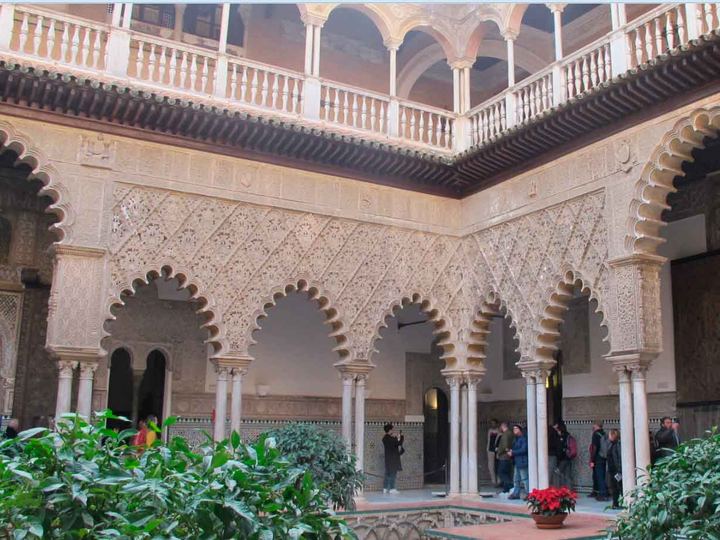
Guided tour of the Cathedral, the Giralda and the Royal Alcázar
Seville's two must-sees with the same official guide and tickets included.
from€65per person
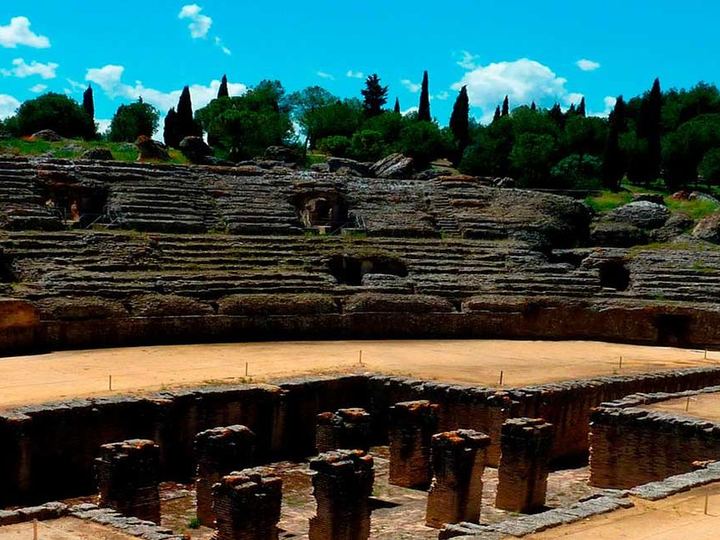
Guided tour of Itálica
The first Roman city in Hispania: amphitheatre, mosaics, baths and theatre. With or without a bus from Seville.
from€21per person